Menus
At the top of the AWG application window is the menu bar, from which you can set several options. Below the menu bar is a toolbar with several frequently used functions.
File:
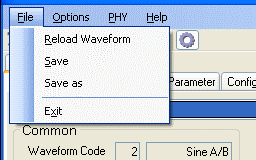
Save
Saves all parameters into current waveform file. The current waveform is listed in the drop-down box in the Waveform panel. For detailed instructions on saving waveforms please see the Save Waveform page.
Save As
Saves all parameters into a new waveform file. A new dialog box will open listing all the parameters and allow you to save it under a new .wfa file name. For detailed instructions on saving waveforms please see the Save Waveform page.
Options:
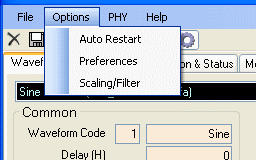
Auto Restart
Automatically restarts AWG memory when you load a new waveform.
Preferences
Brings up the Preferences window:
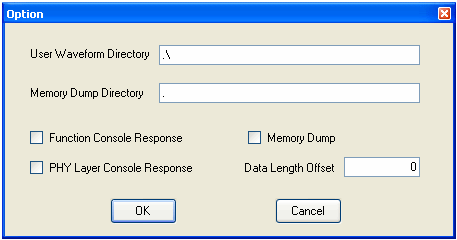
Waveform Directory is the location where you want the waveform files to be saved to. The ".\"
represents the root directory of the program, which you specified during installation. The default is C:\Program Files\Euvis\AWG
Memory Dump Directory is the location where you want the memory dump to be saved to.
Function Console Response enables or disables the Function console. The Function console displays all user commands
that are sent to the board.
PHY Layer Console Response enables or disables the PHY Layer Console. The
PHY Layer Console, at the lower right corner of the AWG window, displays all information that the
application receives from the AWG board.
Memory Dump enables or disables memory dumping. When memory dumping is enabled, the application will dump all
data sent to the board in a .dat file located in the aforementioned Memory Dump Directory.
Data Length Offset specifies how many memory addresses to leave empty at the end of the waveform for more stable
output. At around 2 GHz clock frequency,
set this to "C30".
Scaling/Filtering
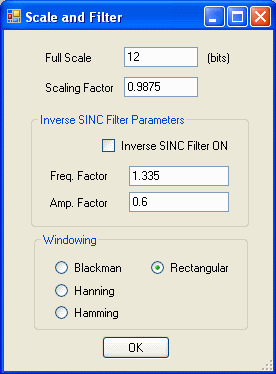
Due to windowing effects from using time-limited waveform data, the frequency spectrum of analog waveforms may appear to have been convolved with a Sinc, and this filter is designed to mitigate the effects of that modulation.
This feature allows you to modify the inverse filter frequency factor, the subsequent window applied, and the full-scale amplitude applied to the analog waveform. Digital waveforms, such as ramp, pulse, and user-defined waveforms, are not affected by these settings. Analog waveforms, which are calculated internally with double precision, go through this inverse sinc filter, windowing, a linear scaling factor, and then are translated to full scale amplitude.
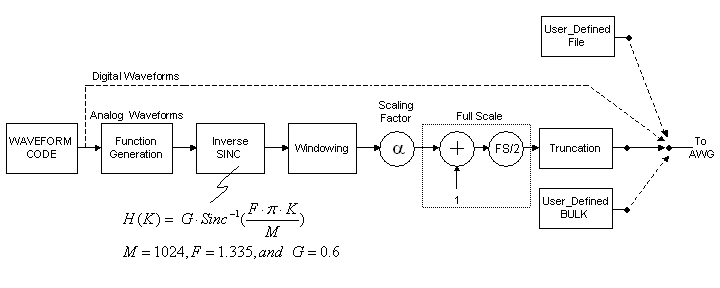
We recommend that you leave the Scaling Factor unchanged at 0.9875, and only use this option to turn on or off the filter. If desired, you can change the type of windowing applied to your analog waveform. Please remember to re-download the waveform data if you change any of these settings.
For an example using the windowing filter, please see Filter in the Waveforms section.
PHY:
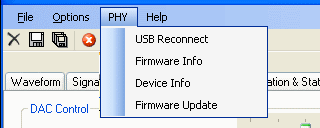
USB Reconnect
Recconects the AWG module to the USB port after it becomes unplugged. Use this feature to reconnect to the AWG after accidentally unplugging the USB port during use.
Firmware Info
Provides information about the firmware:
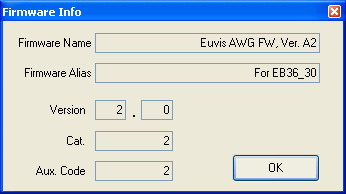
The most important items here are Firmware Name, Firmware Alias and Version number. If you contact us for support, have these items on hand.
Device Info
Provides information about the AWG hardware:
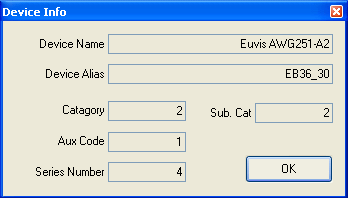
The most important items here are Device Name, Device Alias and Series Number. If you contact us for support, have these items on hand.
Firmware Update
Advanced feature to update the firmware by flashing the ROM:
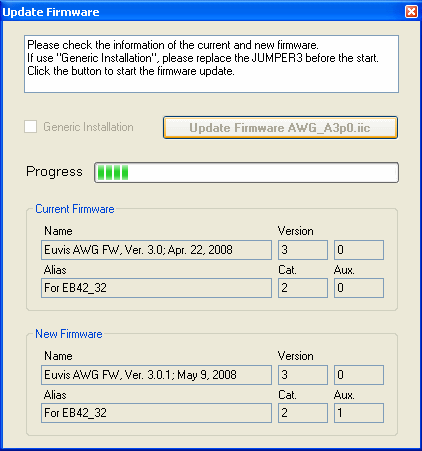
For normal flashing, power up the AWG board with a jumper on JP3 and click on PHY --> Firmware Update to open the above dialog box. The dialog box will show you the current version of the firmware on the device and the new firmware that you will flash on to the ROM. Simply click on Update Firmware to begin the process. It will take approximately 30 to 60 seconds to complete flashing. To register the changes to the application, close the application, power down the board, and then power up the board. When you open the program again and click on PHY --> Firmware Info, it will show the new firmware information.
If there is a major problem with a new firmware, we will recommend to you to do a Generic Installation. To do this, with the AWG power supply turned off, remove the jumper from JP3 on the board. Power up the device and open the AWG application. Go to PHY --> Firmware Update to open the dialog box. Place the jumper back on to JP3. Now click on Update Firmware to begin flashing. To register the changes to the application, close the application, power down the board, and then power up the board. When you open the program again and click on PHY --> Firmware Info, it will show the changed firmware information.
Help:

About
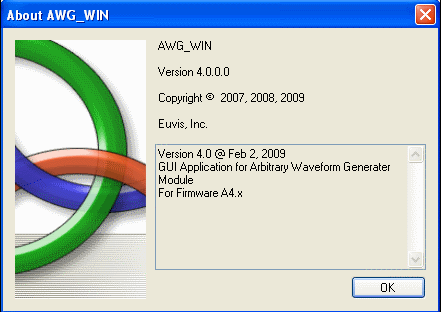
This provides information about the version of software you are running.
Toolbar:
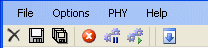
The toolbar is located below the menu bar.
Some commonly used functions are placed
here. These functions are:
Delete Waveform,
Save Waveform,
Save Waveform As ...,
Abort,
Arm&Ready,
Restart,
Streamed Data
Downloading waveforms with long data lengths can be time-consuming. If you use the same waveforms often, you can save the data streams for faster future downloads. See here.