User Defined Waveforms
You can create your own waveforms by loading a custom user defined waveform into the GUI application. To load the file, go to the Waveforms panel and choose the User_Defined (user_defined.wfa) waveform in the drop-down list. Or, select any predefined waveform, and then enter "256" into the Waveform Code box.
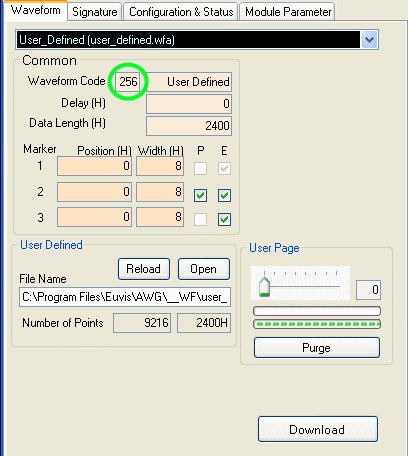
Then, in the User Defined parameters section, click on Open and load the .uda file that you have created. The Data Length will automatically adjust.
User Defined Waveform Files
To create a user defined waveform file you will just need to fill a text file with the waveform information and save the file with
a ".uda" extension.
Click on the file below to see what a user defined waveform file looks like:
For the "#type" there are only two options. If you want to use the GUI to control the markers then you should use "#type=1". By using this type, you can only control the markers with the three marker boxes in the Waveform tab. The other option is to use "#type=5" as was used the example. In this case, you should specify the markers using the second column of the .uda file.
The "#hex=1" signifies that all data are entered as hexadecimal. This is the only data format that you should use.
The first column of the .uda user defined file determines the amplitude of the output.
For the AWG272/452/472, the MUXDAC has 12 bit amplitude resolution, so you
should specify the amplitude within the range from 0 to FFF (hexadecimal).
For the AWG801/872, the MUXDAC uses 11 bit amplitude resolution, so you should specify
the ammplitude within the range from 0 to 7FF (hexadecimal).
The second column is optional and only relevant when you use "#type=5". This column specifies the three marker outputs. You can think of the three markers as three bits. The LSB is for Marker 1, the second LSB is for Marker 2 and the third LSB is for Marker 3. To set any of the markers active you would just set that bit to "1". Therefore when you want to set Marker 1 active, you would set the second column to "1". When you want Marker 3 active you would set the second column to "4". If you wanted all three markers to be active then you would set the second column to "7". The table below shows the different options for the markers:
| Setting | Marker 3 | Marker 2 | Marker 1 |
| 0 | Off | Off | Off |
| 1 | Off | Off | Active |
| 2 | Off | Active | Off |
| 3 | Off | Active | Active |
| 4 | Active | Off | Off |
| 5 | Active | Off | Active |
| 6 | Active | Active | Off |
| 7 | Active | Active | Active |
Unlike the marker settings in the GUI, you can have any of the markers go active multiple times during each waveform. In addition, the marker is active for every four data points, and you must have the marker active on the first of the four data points. If the marker is set to active on the second, third or fourth data points, but not the first, then the marker will not be active. Since Marker 2 has a polarity select, you must still use the "P" checkbox in the Waveform panel to select reverse polarity for that marker. For details about the three available markers, please see the Parameters page of the Operation Details section.