Operation Theory
The conceptual architecture is shown in the following:
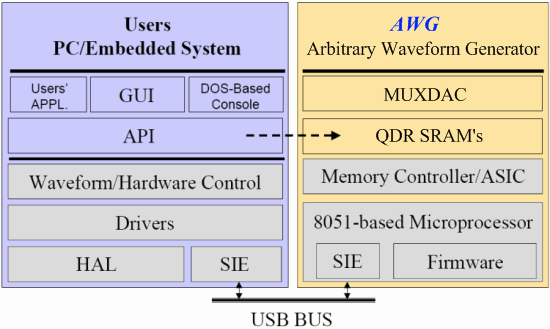
Hardware — The AWG272 consists of two Euvis MD652D high-speed MUXDACs, six QDR SRAMs (Cypress CY7C1313BV18), an ASIC memory controller, and an enhanced 8051 microcontroller (Cypress CY7C68013A) with external RAM and EEPROM. The key front-end component MD652D features >3GHz clock rate, 12-bit amplitude and 13-bit phase resolution. It takes 48 single-ended amplitude word data as inputs. The differential analog outputs are 50 ohm terminated. The waveform data are stored in the QDR SRAMs, which provide 4M x 12-bit memory depth.
The AWG452 uses the Euvis MD681S high-speed MUXDAC and six QDR SRAMs (Cypress CY7C1313BV18). The MD681S features a >4GHz clock rate and 12-bit amplitude resolution. It receives 96 single-ended amplitude word data as inputs, which are stored in the QDR SRAMs, which provide 8M x 12-bit memory depth.
The AWG472 uses two Euvis MD681S high-speed MUXDACs and six QDR SRAMs (Cypress CY7C1515KV18) to achieve dual channel operation. The MD681S features a >4GHz clock rate and 12-bit amplitude resolution. Each MD681S receives 96 single-ended amplitude word data as inputs, which are stored in the QDR SRAMs, which provide 2 x 8M x 12-bit memory depth.
The AWG801 uses the Euvis MD662H high-speed MUXDAC plus four Euvis MX4411 high-speed multiplexers and six QDR SRAMs (Cypress CY7C1315BV18). The MD662 features a >4GHz clock rate and 12-bit amplitude resolution. It receives 88 differential amplitude word data as inputs, which are 4:1-muxed from data stored in the QDR SRAMs, which provide 8M x 11-bit memory depth.
The AWG872 uses two Euvis MD662H high-speed MUXDACs plus eight Euvis MX4411 high-speed multiplexers and twelve QDR SRAMs (Cypress CY7C1315BV18) to achieve dual channel operation. The MD662 features a >4GHz clock rate and 12-bit amplitude resolution. Each MD662 receives 88 differential amplitude word data as inputs, which are 4:1-muxed from data stored in the QDR SRAMs, which provide 2 x 8M x 11-bit memory depth.
The ASIC memory controller performs reading/writing controls and data transfers. The microcontroller has an integrated USB 2.0 transceiver, a series interface engine (SIE) and an enhanced 8051 microprocessor, which provides a user friendly interface for the host PC or existing systems and general-purpose controls.
Software — The companion API (Application Programming Interface) performs all the hardware controls and handles the data transfers on the user end. The gray-color blocks represent user-invisible kernel layers in the operations. All of the user operations/commands are executed virtually onto the QDR SRAMs and the MUXDAC on the AWG even though physically the bulk of the instructions are transferred via the USB bus and executed by the kernel layers. This virtual connection between the API and RAM provides a clean and simple interface for users to develop their own application software without the trivial knowledge of the low-level drivers, the USB interface, the firmware, and the control hardware.
The API consists of a set of callable routines in Microsoft Visual C++ library. Users can develop their own application software to operate the AWG in their own manner or modify the existing system to adopt the AWG into their end products. The API consists of three groups of functions:
- Waveform generation: The built-in waveform generator takes users’ parameter inputs, computes the digital codes, and downloads the codes onto the RAM’s accordingly. The built-in waveforms include monotonic sine waves, multi-tone sine waves, triangle waves, square waves, and high-speed linear chirping CW FM waveforms that can have frequency updates at each clock cycle.
- Waveform control: The waveform control function downloads the digital data onto the RAM in the writing phase, controls the AWG, and provides the RAM’s cyclic addresses in the reading phase. It also controls the cyclic depth.
- Import/Export waveforms: The API provides routines to import user-defined waveform data in various formats, such as x-y ASCII format and MATLAB compatible ASCII format. On the other hand, all the built-in waveforms can be exported to files for analysis.
In addition to the API, a console-based control program and a Windows-based graphical control program provide users convenient ways to control and operate the AWG.