Operation Examples -
The module can be configured as a Master module to activate other modules configured as Slave modules. By default, the module is in Master mode. To configure the module in Slave mode, the Master property can be turned off via the GUI or the API-based applications.
As a master, after receiving the trigger signal, the module generates a SYNCO signal, which can be used to activate the slave modules. The configuration is shown in the following figure.
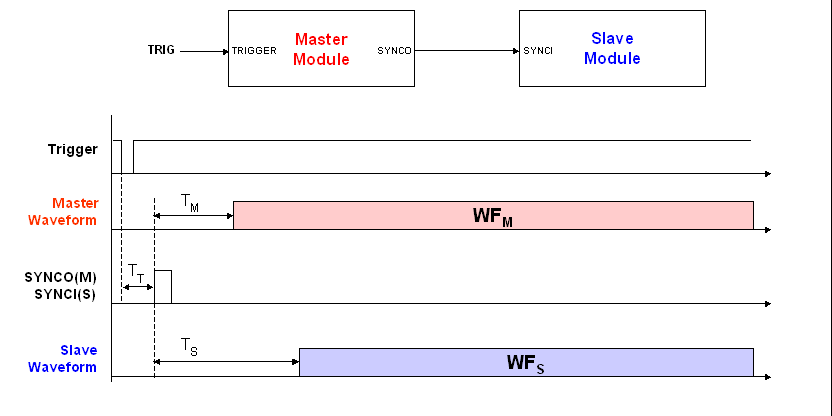
Master with one slave
We will now present an example of setting up one Master board to control one Slave board.
» Plug the power supplies into each board, ensuring that the power source
is capable of twice the current requirements as for one board.
» Connect the necessary SMA cables to the Master and Slave boards. Note that you must connect the SYNCOUT on the Master
Board to SYNCIN in the slave board. The input clock power should be increased by 6dB and then split via a 6dB power
divider and input to both CKIP inputs on the Master and Slave boards.
If you are using a trigger signal, connect it to the TRIG connector on the Master board. The Slave board will ignore any TRIG signal, so it is not necessary to split the TRIG signal. If you are not using both of the OUTP and OUTN outputs on both boards, you may terminate the unused ones with 50 ohm terminal resistors.
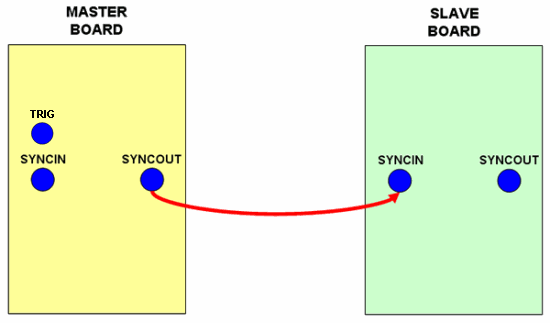
» Now connect both boards to the computer using two USB A-to-B cables.
» Power up the AWG boards by plugging in the power supplies. Remember that you should set up your power connectors in the right order as
specified in the Hardware Setup page.
» You will need to open two instances of the AWG application. When you open the first AWG application, a dialog box will pop up allowing you to choose
the board number.
Each board is identified by a series number. We will make one our Master board and the our Slave board. In this case, we select #4 and click OK.
» The AWG application will now open. If you look at the title bar, you will notice that it has the board number so that
you can identify the boards easily.
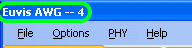
» Now open up a second AWG program. Again the dialog box will appear.
Choose the series number of the second board and then click on OK.
» Once again you will notice that the title bar will have the board's number.
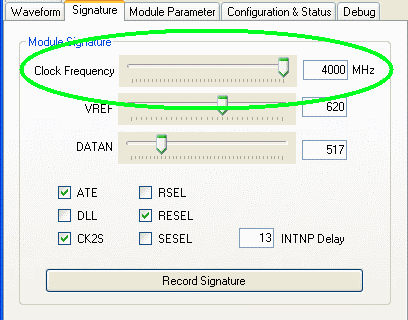
» Go back to the Master board application. Adjust the Clock Frequency so that it matches the input clock
frequency. Our clock is at 4.0 GHz, so we will
set it to "4000" with the units in "MHz". Repeat the same procedure with the Slave board
application.
» Go back to the Master application and click on the "Configuration and Status" tab. Change the configuration so that
only Master is checked. Leave the Guard Length unchanged at 40 (hex).
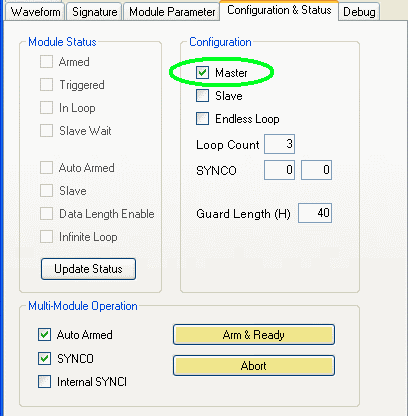
» In the Master application, make sure that Auto Armed and SYNCO are checked. Also, you will notice that Loop Count
is set to "3". For an explanation of these parameters, please
see the Internal States section in the Module Parameters page.
» Now go to the Slave application and click on the "Configuration and Status" tab. Change the configuration so that
only Slave is checked. Change the Guard Length to 30 (hex). You may
need to adjust this Guard Length after you see the waveforms.
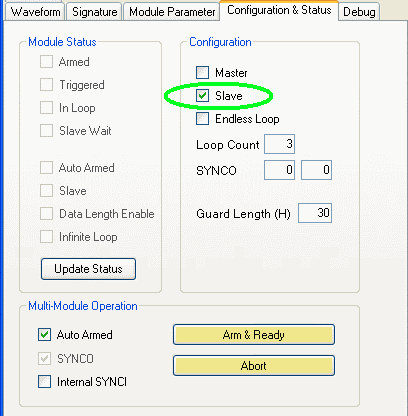
» In the Slave application, make sure that Auto Armed is checked. Although the SYNCOUT checkbox is available, it has no effect on the board even if you change any of the values or enable it. Slave boards never output a SYNCO signal. Also, you will notice that Loop Count is set to "3".
The Slave board does not have to mirror the output of the Master board. The Master board merely synchronizes the Slave board so that they begin outputting waveforms at the same time. The two boards can output two different waveforms at the same time and even different numbers of waveforms so you can change Loop Count to whatever value you desire as long as it is LESS than or equal to the loop count of the Master board.
Two slaves synchronized
We will now present an example of setting up two Slave boards. They will be synchronized because they have the same TS delay. The SYNCI signal should come from an external trigger source (which can be a Master board or just a positive pulse from a function generator).
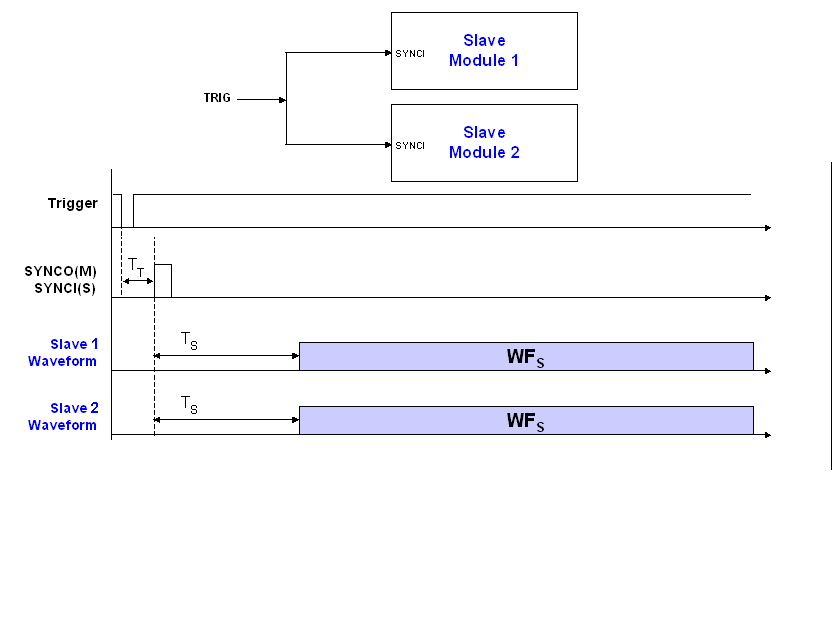
» Plug the power supplies into each board, ensuring that the power source is capable of twice the current requirements as for one board.
» Connect the necessary SMA cables to the two Slave boards. Note that you must split
your trigger source to connect to the SYNCIN connectors on both slave board. Since
SYNCI is triggered by the rising edge, this trigger signal is the opposite
of the falling edge trigger signal used to trigger a Master board. The input clock
power should be increased by 6dB and then split via a 6dB power divider and input
to both CKIP inputs on the Slave boards.
If you are not using both of the OUTP and OUTN outputs on both boards, you may terminate the unused ones with 50 ohm terminal resistors.
» Now connect both boards to the computer using two USB A-to-B cables.
» Power up the AWG boards by plugging in the power supplies. Remember that you should
set up your power connectors in the right order as specified in the
Hardware Setup page.
» You will need to open two instances of the AWG application. When you open the
first AWG application, a dialog box will pop up allowing you to choose the board
number.
Each board is identified by a series number. In this case, we select #4 and click OK.
» The AWG application will now open. If you look at the title bar, you will notice
that it has the board number so that you can identify the boards easily.
» Now open up a second AWG program. Again the dialog box will appear.
Choose the series number of the second board and then click on OK.
» Once again you will notice that the title bar will have the board's number.
» In the signature panel of each application window, adjust the Clock Frequency
so that it matches the input clock frequency. Our clock is at 4.0 GHz, so we will
set it to "4000" with the units in "MHz". Repeat the same procedure in the other
application window.
» In the Configuration & Status panel of each application window, change the
configuration so that only Slave is checked. You can leave the
Guard Length unchanged. But, if you change it, please ensure that it is changed
to the same value in the other application window.
» In each application, make sure that Auto Armed is checked. Although the SYNCOUT checkbox is available, it has no effect on the board even if you change any of the values or enable it. Slave boards never output a SYNCO signal. Also, you will notice that Loop Count is set to "3".
The two Slave boards doe not have to match each other. This process merely synchronizes the Slave boards so that they begin outputting waveforms at the same time. The two boards can output two different waveforms at the same time and even different numbers of waveforms, so you can change Loop Count to whatever value you desire.