Triggered Free Run Mode
In Triggered Free Run mode, the operation manner is similar to that in Free Run/Continuous mode except for the start of waveform generation.
In this mode, waveform generation is initiated by a trigger signal. In order to accept the upcoming trigger signals, the module must be armed prior the acceptance of the trigger signals. Trigger signals received before the module is armed will be ignored. An Arm command from the GUI or API-based applications can be used to arm the module. Once the module is armed, it waits for the trigger signal.
The waveform generation starts after the falling edge of the trigger signal. The trigger signal can be applied via the TRIG SMA connector or provided by a command Trigger via the GUI or API-based applications. Due to the asynchronous timing between the upcoming trigger signal and the module clocking, there will be some uncertain delay/latency between the trigger and the waveform generation. However, the waveform generation is synchronized with respect to the module clock.
After waveform generation has begun, the module proceeds as if in Free Run/Continuous mode. It will repeat the waveform continuously. There is no latency between two consecutive waveforms. The following waveform starts right after the end of the preceding waveform. The waveform generation can be aborted by an Abort command from the GUI or API-based applications.
» With the program open, click on the Waveform tab if you are not already in the Waveform Panel.
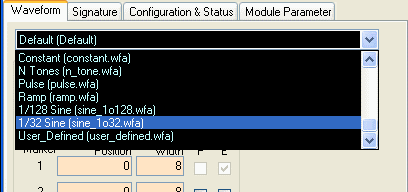
» Click on the drop-down list and select one of the saved waveforms, such as "1/32 Sine (sine_1o32.wfa)", which is a Sine wave at 1/32th of the clock frequency. The files have the extension .wfa and are stored in your application folder or the user-defined waveform directory. You can adjust various parameters if desired.
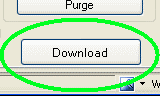
Click on Download Waveform near the bottom of the window or click on File --> Load Waveform. Wait several seconds for the file to finish downloading.
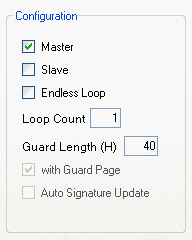
» Click on the Configuration and Status tab. In the Configuration section, check the box for Master, and ensure that Endless Loop is also checked.
Then press the Arm&Ready button in the toolbar, which is the 5th button from the left in the area between the menu bar and the panel tabs.
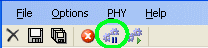
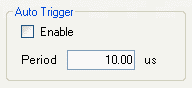
Finally, apply a trigger signal, either via the TRIG SMA on the module or by enabling the internal trigger with the Auto Trigger checkbox in the Configuration section of the Configuration & Status Tab. If you are using an external trigger, you may want to turn off the internal trigger, because the module will accept both internal and external triggers.